Guide to Rock Types: Sedimentary, Igneous, and Metamorphic

Geologists organise all rocks into three categories based on the process that produced them. This classification — sedimentary, igneous, and metamorphic — is not merely academic. In the field, identifying which category a rock belongs to immediately tells you something about its formation environment, likely mineral content, and the structural history of the region you are standing in.
Poland's territory spans multiple tectonic and stratigraphic provinces, which means all three rock types appear within its borders, often in close proximity. The Carpathian flysch sequences in the south are sedimentary; the granite batholiths of the Karkonosze are igneous; the gneisses and schists of the Fore-Sudetic Block are metamorphic. Understanding which is which is the starting point for any fieldwork.
Sedimentary Rocks
Sedimentary rocks form at or near Earth's surface through the accumulation and lithification of particles transported by water, wind, ice, or gravity. The process involves deposition of sediment in layers, followed by compaction as new material accumulates above, and cementation as minerals precipitate from groundwater to bind particles together.
The Kraków–Częstochowa Upland is one of the most accessible sedimentary sequences in Poland. Jurassic limestones, deposited in warm, shallow marine conditions roughly 155 to 145 million years ago, form the characteristic monadnock ridges of the area. These same limestones contain the ammonites, belemnites, and echinoids that make this region of particular interest to fossil collectors.
Clastic Sedimentary Rocks
Classified by grain size: conglomerate (gravel-sized grains), sandstone (sand-sized), siltstone (silt-sized), and shale (clay-sized). Grain size reflects the energy of the depositional environment — coarser material settles in high-energy settings such as river channels and beaches, while fine clay accumulates in calm, deep water.

Chemical and Biogenic Sedimentary Rocks
Limestone forms from the accumulation of calcite-shelled organisms or direct precipitation of calcium carbonate from seawater. The Devonian reef complexes of the Holy Cross Mountains represent a biogenic limestone sequence with exceptionally well-preserved fauna. Rock salt and gypsum, present in the Permian Zechstein deposits of the Polish Lowlands, are examples of chemical (evaporite) sedimentary rocks.
Look for layering (bedding), which is the most reliable indicator. Sedimentary rocks often contain fossils, show graded bedding, and have surfaces that split along parallel planes. Limestone reacts visibly with dilute hydrochloric acid by fizzing.
Common Sedimentary Rocks in Poland
| Rock | Key Characteristics | Where Found in Poland |
|---|---|---|
| Limestone | Light grey to beige, fizzes with acid, often fossiliferous | Kraków–Częstochowa Upland, Holy Cross Mountains |
| Sandstone | Granular texture, visible grains, often cross-bedded | Carpathian flysch, Sudeten foreland |
| Shale | Fine-grained, splits in thin sheets, dull surface | Carpathian flysch sequences |
| Rock Salt | Cubic cleavage, soluble in water, salty taste | Wieliczka, Bochnia (Miocene evaporites) |
Igneous Rocks
Igneous rocks crystallise from molten material. When magma cools slowly beneath the surface, large crystals grow and the resulting rock is coarse-grained — this is intrusive (plutonic) rock. When lava erupts and cools quickly, there is little time for crystals to form, producing fine-grained or glassy extrusive (volcanic) rock.

Intrusive Igneous Rocks in Poland
The Karkonosze granite pluton in the Sudeten is the largest granite body in Poland, emplaced during the Variscan orogeny approximately 320 to 300 million years ago. It consists primarily of alkali feldspar, plagioclase, quartz, and biotite. The granite is exposed along river valleys and ridge crests throughout the Karkonosze National Park and is quarried commercially in the region.
Pegmatites associated with the Sudeten granites contain accessory minerals of interest to collectors, including tourmaline, topaz, and rare earth phosphates. The Strzegom–Sobótka pegmatite field has been a documented source of mineral specimens for over a century.
Extrusive Igneous Rocks in Poland
The Lower Silesian volcanic field, centred near Złotoryja in the Kaczawa Hills, contains basalt flows and necks of Cenozoic age. Columnar-jointed basalt exposures at Organy Wielisławskie near Wielisław Złotoryjski are a well-known geological outcrop. These basalts are geochemically classified as alkali olivine basalts and contain olivine phenocrysts and occasional xenoliths of mantle peridotite.
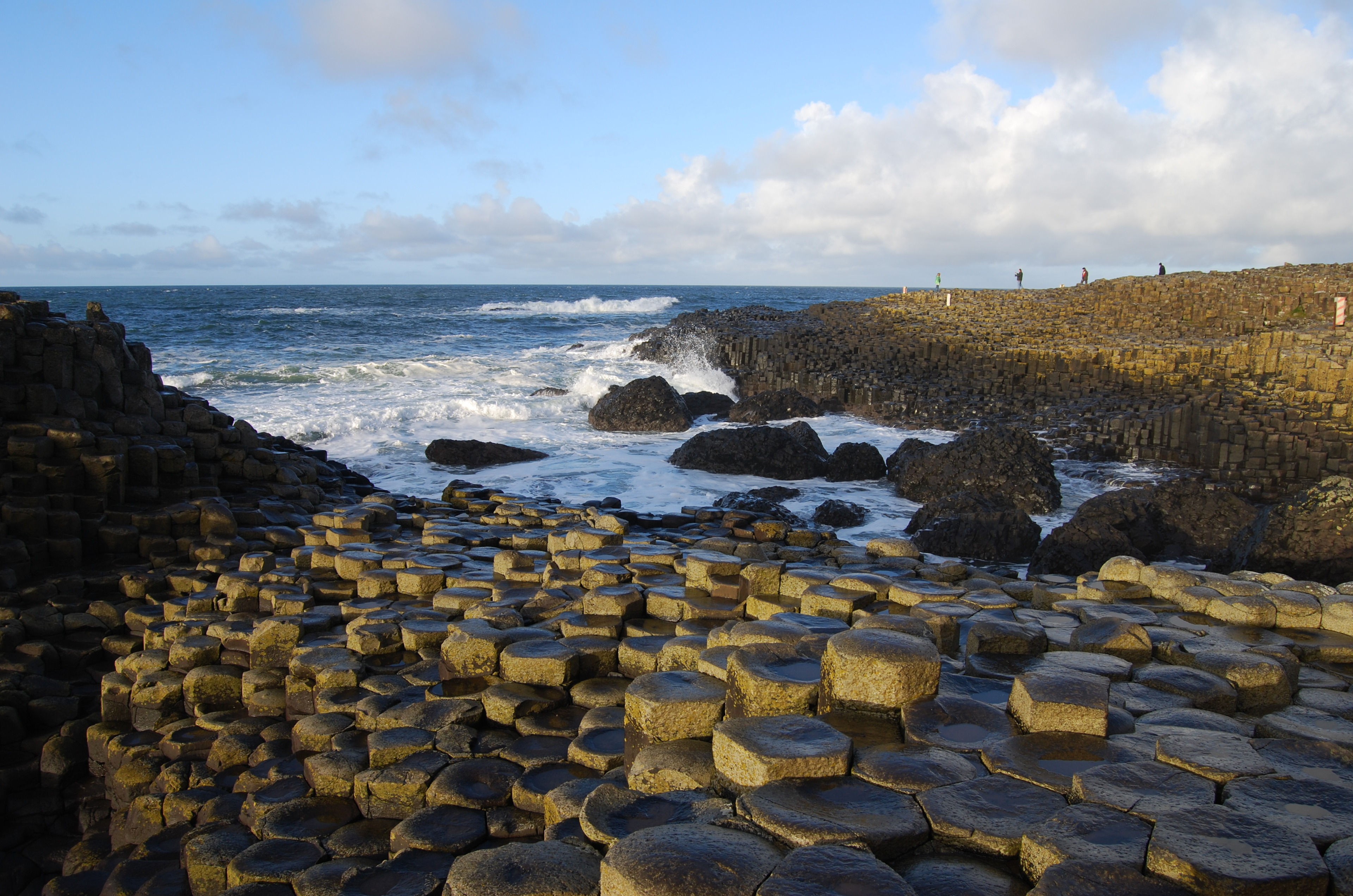
Look for interlocking crystals without layering (granite), a very fine groundmass with no visible crystals (basalt), or a glassy appearance. Gas bubbles (vesicles) in volcanic rocks indicate rapid degassing. No fossils occur in primary igneous rocks.
Metamorphic Rocks
When existing rock — igneous, sedimentary, or earlier metamorphic — is subjected to elevated temperature and pressure without melting, the minerals recrystallise and new mineral assemblages develop. This transformation produces metamorphic rock. The grade of metamorphism increases with temperature and pressure, progressing from low-grade (slate) through intermediate (schist) to high-grade (gneiss).
The Sudeten mountain range exposes some of the oldest and most intensely metamorphosed rocks in Poland. The Orlica–Śnieżnik Dome contains ortho- and paragneisses that preserve evidence of high-pressure metamorphism during the Variscan event. These rocks now outcrop at the surface because millions of years of erosion have removed the overlying material.
Foliation and Texture
Most metamorphic rocks exhibit foliation — a planar fabric produced by the alignment of platy minerals such as mica and chlorite under directed pressure. Slate has a very fine foliation called slaty cleavage; phyllite has a slightly coarser fabric with a silky sheen; schist shows well-developed mica flakes visible to the naked eye; gneiss displays compositional banding of light and dark minerals.
Foliation planes in metamorphic outcrops record the orientation of the stress field at the time of metamorphism. Measuring these planes provides information about the geometry of the ancient mountain-building event that produced the rock.
Look for foliation or banding, shiny mica flakes on cleavage surfaces, and a crystalline texture without fossils. Marble (metamorphosed limestone) lacks foliation but reacts with acid. Quartzite (metamorphosed sandstone) is very hard and has an interlocking quartz texture.
The Rock Cycle
The three rock categories are connected through the rock cycle: igneous rocks exposed at the surface weather into sediment that accumulates and lithifies into sedimentary rock; both igneous and sedimentary rocks can be buried and metamorphosed; metamorphic rock can melt to form magma, which crystallises into igneous rock. Erosion and tectonic processes drive the cycle.
In the Sudeten and Carpathian regions, all stages of this cycle are documented in the geological record. The Polish Geological Institute (PIG-PIB, pgi.gov.pl) maintains detailed geological maps of Poland at scales from 1:50,000 to 1:500,000, which are available through their online portal and are a primary reference for field planning.