Mineral Identification: Properties, Tests, and Common Species
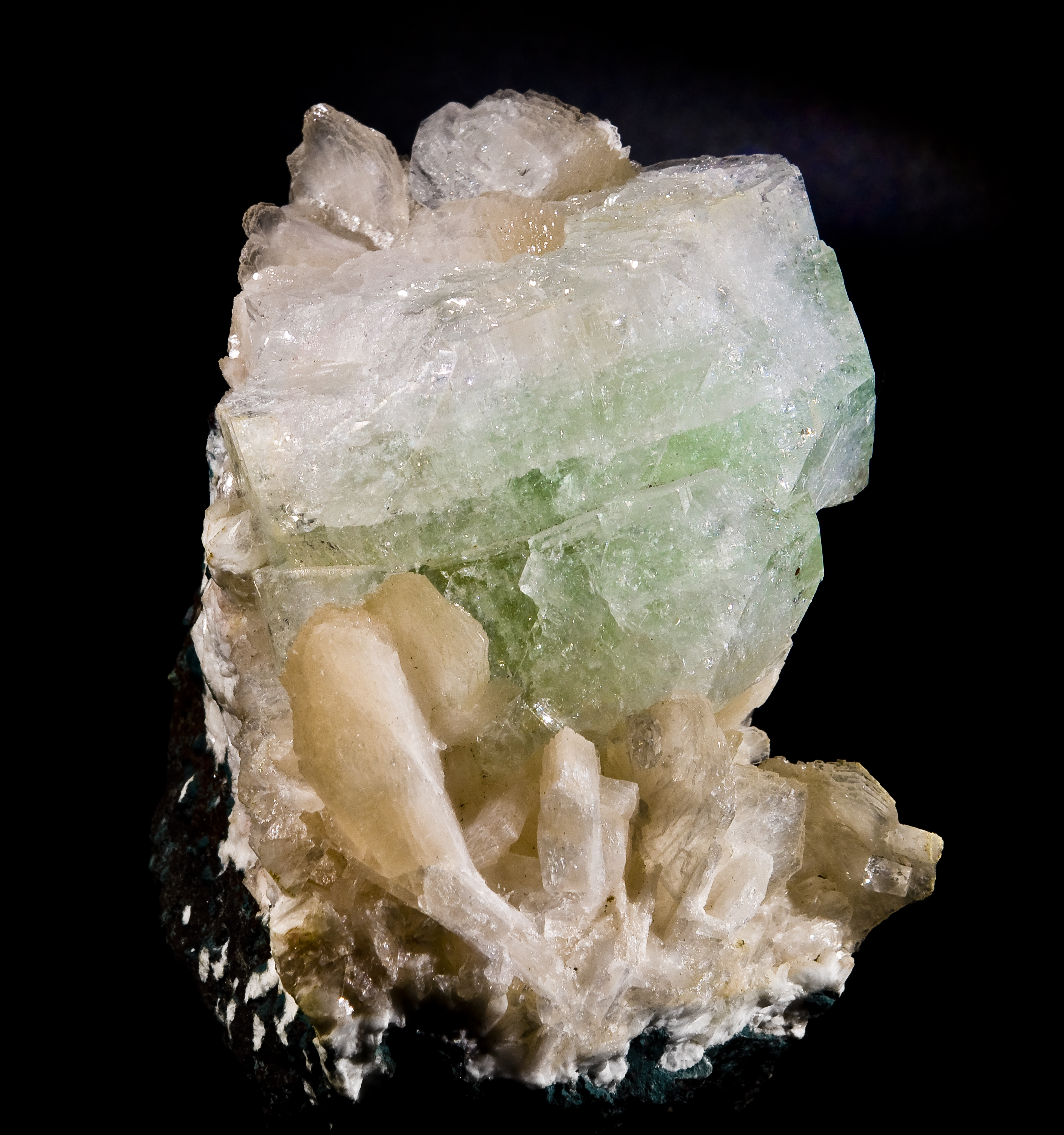
Mineral identification in the field and at the desk relies on a systematic examination of physical properties. Unlike rock classification, which addresses the bulk material, mineral identification targets individual crystalline phases. Each mineral has a fixed or narrowly constrained chemical composition and a characteristic crystal structure, which together determine the physical properties used to tell specimens apart.
This page covers the principal diagnostic properties and applies them to minerals commonly collected from Polish localities. The reference database at Mindat.org lists Poland as a significant source locality for over three hundred mineral species, from the abundant rock-forming silicates to rarer accessory phases in Sudeten pegmatites.
Diagnostic Properties
Hardness
Hardness describes resistance to scratching and is measured against the Mohs reference scale, which runs from 1 (talc) to 10 (diamond). In practice, a fingernail (approximately 2.5), a copper coin (approximately 3.5), a steel knife blade (approximately 5.5), and a piece of quartz (7) cover the range of most field tests.
Always test on a fresh, unweathered surface. Weathered rinds are consistently softer than the interior of the mineral. Testing the hardness of the scratching material against the specimen confirms which is harder — the scratched surface shows the mark, the harder material does not.
1 Talc · 2 Gypsum · 3 Calcite · 4 Fluorite · 5 Apatite · 6 Orthoclase · 7 Quartz · 8 Topaz · 9 Corundum · 10 Diamond. Each mineral on the scale scratches all minerals below it.
Cleavage and Fracture
Cleavage is the tendency of a mineral to break along planes of weak atomic bonding parallel to crystal faces. It is described by the number of cleavage directions, the angles between them, and the quality (perfect, good, poor). Calcite has three perfect cleavages at oblique angles, producing rhombohedral fragments. Micas have one perfect basal cleavage, yielding thin flexible sheets. Quartz has no cleavage and instead shows conchoidal fracture — smooth, curved surfaces resembling broken glass.
Luster
Luster describes how light reflects from a mineral surface. The two main categories are metallic (opaque, highly reflective, like a metal surface) and non-metallic. Non-metallic varieties include vitreous (glassy, as in quartz and most silicates), resinous (like amber), pearly (resembling pearl, found on cleavage faces of talc and micas), silky (fibrous minerals such as satin spar gypsum), and adamantine (intensely bright, like diamond).
Streak
Streak is the colour of the powdered mineral produced by drawing it across an unglazed porcelain plate. It is more diagnostic than the colour of the hand specimen because surface colour can vary with impurities while streak colour stays consistent. Pyrite has a brassy yellow colour but a greenish-black streak; hematite has a metallic grey surface but a characteristic red-brown streak.
Crystal Habit and Form
Many minerals develop characteristic crystal shapes when space permits free growth. Pyrite forms cubic crystals with striated faces. Quartz grows as six-sided prisms terminated by pyramidal faces. Garnet typically forms dodecahedral or icositetrahedral crystals. When crystals are not well-formed, habit terms such as massive, granular, botryoidal, acicular, or fibrous describe the aggregate texture.
Key Minerals in Polish Geology

Quartz (SiO₂)
Hardness 7, vitreous to waxy luster, white streak, conchoidal fracture, no cleavage. Occurs as colourless rock crystal, white milky quartz, purple amethyst, and smoky grey morion. In Poland, vein quartz is found throughout the Sudeten; gem-quality amethyst and smoky quartz have been recovered from pegmatites near Szklary, Gogołów-Jordanów, and other Lower Silesian localities. The Mindat database lists the Karkonosze pegmatite field as a documented source of rock crystal.
Feldspar Group
The feldspars — orthoclase and plagioclase — are the most abundant minerals in the continental crust. Hardness 6 to 6.5, two cleavage directions at approximately 90° (orthoclase) or 86° (plagioclase), vitreous to pearly luster on cleavage faces. Orthoclase and microcline occur as the dominant pinkish or whitish crystals in Karkonosze granite. Plagioclase appears as whitish to greyish plates in the same rocks and in the gabbros and diorites of the Sudeten.
Calcite (CaCO₃)
Hardness 3, three perfect rhombohedral cleavage directions, vitreous to pearly luster, white streak. The most reliable field test is reaction with dilute hydrochloric acid: calcite effervesces immediately. It is the dominant mineral of the Jurassic limestones of the Kraków–Częstochowa Upland and occurs as scalenohedral crystals in mineralised veins in the Holy Cross Mountains. Stalactites and flowstone in the Ojców cave system are composed almost entirely of calcite.
Pyrite (FeS₂)
Hardness 6 to 6.5, metallic luster, greenish-black streak, cubic crystal form with striated faces. Pyrite occurs as an accessory phase in many rock types but is particularly common in the metamorphic and hydrothermal vein deposits of the Sudeten. The Złoty Stok gold-arsenic deposit in Lower Silesia, worked historically for gold and arsenic, contains pyrite and arsenopyrite as primary ore minerals. The mine is now a tourist attraction and a documented geological site.
Fluorite (CaF₂)
Hardness 4, four perfect octahedral cleavage directions, vitreous luster, white streak. Colour is highly variable — purple, green, yellow, and colourless phases occur within the same deposit. Fluorite is a gangue mineral in hydrothermal veins and occurs with galena, sphalerite, and calcite in the Sudeten mineralisation zones, including the Kowary and Kletno mining districts.
Galena (PbS)
Hardness 2.5, perfect cubic cleavage, bright metallic luster, grey streak, high specific gravity. Galena is the principal ore of lead and was historically mined in the Olkusz region of Małopolska, where it occurs in stratiform deposits within Triassic dolomites. These deposits also contain sphalerite (zinc ore) and marcasite. The Olkusz mineralisation is one of the largest lead-zinc districts in Europe and has been the subject of extensive research by the Faculty of Geology at the University of Warsaw.
| Mineral | Hardness | Cleavage | Key Test | Occurrence in Poland |
|---|---|---|---|---|
| Quartz | 7 | None (conchoidal fracture) | Scratches glass | Sudeten pegmatites, vein quartz |
| Calcite | 3 | 3 perfect (rhombohedral) | Fizzes with HCl | Jurassic limestones, cave deposits |
| Pyrite | 6–6.5 | Poor | Cubic crystals, greenish-black streak | Sudeten veins, Złoty Stok |
| Fluorite | 4 | 4 perfect (octahedral) | Scratched by knife, not by coin | Kowary, Kletno vein zones |
| Galena | 2.5 | 3 perfect (cubic) | High density, bright metallic luster | Olkusz Pb-Zn district |
| Orthoclase | 6–6.5 | 2 at 90° | Pink to white, two cleavages at right angles | Karkonosze granite |
Identification Approach in the Field
A systematic sequence minimises errors. Begin with hardness because it can be tested on almost any surface without equipment. Follow with luster and streak, both of which require only a porcelain plate and observation. Then assess cleavage by examining break surfaces under magnification if available. Crystal habit and colour provide supporting evidence but should not be used as primary identifiers because both vary considerably.
For amphibolites, gneisses, and other metamorphic rocks containing interlocking mineral grains, identification requires a hand lens at minimum. A 10× loupe is the standard field tool. For ambiguous specimens, a thin section examined under a petrographic microscope provides definitive identification based on optical properties — this service is available through university geology departments and geological institutes.
Minimum useful kit: 10× hand lens, streak plate (unglazed porcelain), small bottle of dilute HCl (5–10%), steel knife, copper coin, and a reference field guide to European minerals. The Mindat mobile application provides a searchable mineral database with locality data.